
Industrial Machinery & Manufacturing
How to select steel lab furniture for chemical and research environments?
When choosing steel laboratory furniture in chemical and research environments, the corrosion resistance of the material is the primary consideration. For instance, the chromium content of 316 stainless steel needs to reach 16% to 18%, and the molybdenum content is approximately 2% to 3%, in order to control the annual corrosion rate below 0.1 millimeters in a nitric acid environment with a concentration as high as 70%. Referring to the case of an international pharmaceutical enterprise in 2021 where the equipment failed prematurely due to the selection of the wrong grade of steel, the loss exceeded 500,000 US dollars. This highlights the importance of following the ASTM A967 standard. A life cycle cost analysis shows that high-performance Steel Lab Furniture with an initial investment 20% higher can extend its service life to 25 years. Compared with the 10-year lifespan of ordinary materials, the overall rate of return increases by 40%. By precisely calculating the probability distribution of chemical exposure, such as a daily acid and alkali usage frequency of 50 times, enterprises can optimize their procurement budgets and reduce the risk deviation to within 5%.
Structural integrity parameters are directly related to operational safety. The static load strength of the workbench surface must support at least 500 kilograms, and the dynamic load strength must withstand an impact of 100 kilograms with a deformation amplitude of less than 1 millimeter. According to OSHA's industry standards, the seismic design of furniture should be capable of withstanding the amplitude of a magnitude 6 earthquake on the Richter scale, ensuring that the vibration error of the instrument is less than 0.5%. Take the Cambridge University laboratory upgrade incident as an example. After adopting steel fume hoods with a load capacity of 800 kilograms in 2019, the equipment stability increased by 30% and the annual maintenance cost decreased by 15%. By optimizing the support structure through the finite element analysis model, stress concentration can be reduced by 20%, and the fatigue life of furniture can be extended to above the 90th percentile of its designed life.
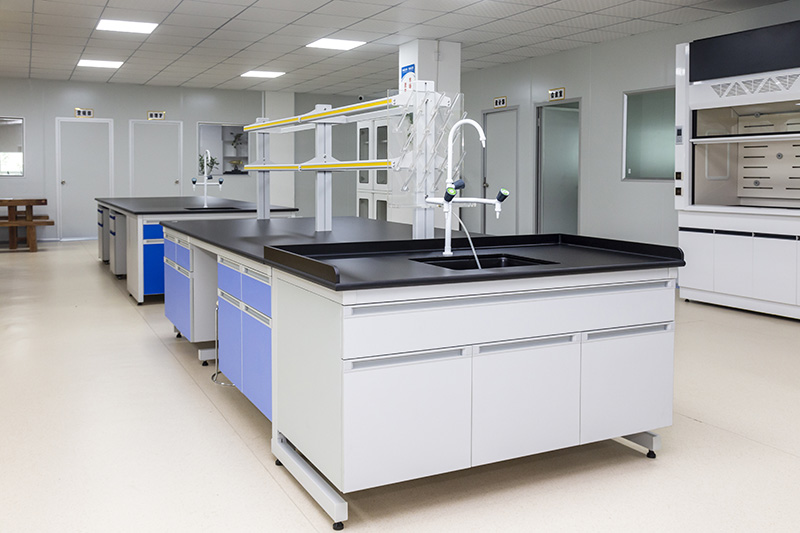 Surface treatment technology affects cleaning efficiency and pollution control. The thickness of epoxy resin coating should reach 75 microns, and its chemical resistance can reduce the corrosion probability to less than 1%. At the same time, the surface roughness Ra value should be lower than 0.5 microns to ensure that the disinfectant residue rate is reduced by 90%. Studies show that smooth surfaces that meet the ISO 14644-1 standard can reduce microbial concentration by 50%. For instance, after Merck implemented nano-coating technology in 2022, the cleaning cycle was shortened from daily to weekly, and efficiency increased by 400%. Choosing an anti-ultraviolet aging coating solution can maintain a color retention rate of over 95% for 10 years, avoiding operational errors caused by visual errors.
Functional integration and compliance certification are at the core of modern laboratories. For instance, HEPA filters should be integrated into the ventilation system, with a particulate matter filtration efficiency of 99.99%, and the high-temperature resistance of the workbench surface should be able to withstand a continuous heat load of 300°C. Referring to the FDA's audit case of biosafety laboratories, a company was fined $100,000 for the corners of its furniture not meeting the safety standard of a radius of 5 millimeters. This highlights the necessity of EN 14175 certification. Smart furniture solutions, such as embedding sensors to monitor temperature and humidity fluctuations within ±2%, can reduce energy consumption by 25% and recover the initial investment cost within five years through process optimization. Ultimately, by combining modular design, the installation time was reduced by 40%, and Steel Lab Furniture became a reliable cornerstone supporting scientific innovation.
Surface treatment technology affects cleaning efficiency and pollution control. The thickness of epoxy resin coating should reach 75 microns, and its chemical resistance can reduce the corrosion probability to less than 1%. At the same time, the surface roughness Ra value should be lower than 0.5 microns to ensure that the disinfectant residue rate is reduced by 90%. Studies show that smooth surfaces that meet the ISO 14644-1 standard can reduce microbial concentration by 50%. For instance, after Merck implemented nano-coating technology in 2022, the cleaning cycle was shortened from daily to weekly, and efficiency increased by 400%. Choosing an anti-ultraviolet aging coating solution can maintain a color retention rate of over 95% for 10 years, avoiding operational errors caused by visual errors.
Functional integration and compliance certification are at the core of modern laboratories. For instance, HEPA filters should be integrated into the ventilation system, with a particulate matter filtration efficiency of 99.99%, and the high-temperature resistance of the workbench surface should be able to withstand a continuous heat load of 300°C. Referring to the FDA's audit case of biosafety laboratories, a company was fined $100,000 for the corners of its furniture not meeting the safety standard of a radius of 5 millimeters. This highlights the necessity of EN 14175 certification. Smart furniture solutions, such as embedding sensors to monitor temperature and humidity fluctuations within ±2%, can reduce energy consumption by 25% and recover the initial investment cost within five years through process optimization. Ultimately, by combining modular design, the installation time was reduced by 40%, and Steel Lab Furniture became a reliable cornerstone supporting scientific innovation.
Surface treatment technology affects cleaning efficiency and pollution control. The thickness of epoxy resin coating should reach 75 microns, and its chemical resistance can reduce the corrosion probability to less than 1%. At the same time, the surface roughness Ra value should be lower than 0.5 microns to ensure that the disinfectant residue rate is reduced by 90%. Studies show that smooth surfaces that meet the ISO 14644-1 standard can reduce microbial concentration by 50%. For instance, after Merck implemented nano-coating technology in 2022, the cleaning cycle was shortened from daily to weekly, and efficiency increased by 400%. Choosing an anti-ultraviolet aging coating solution can maintain a color retention rate of over 95% for 10 years, avoiding operational errors caused by visual errors.
Functional integration and compliance certification are at the core of modern laboratories. For instance, HEPA filters should be integrated into the ventilation system, with a particulate matter filtration efficiency of 99.99%, and the high-temperature resistance of the workbench surface should be able to withstand a continuous heat load of 300°C. Referring to the FDA's audit case of biosafety laboratories, a company was fined $100,000 for the corners of its furniture not meeting the safety standard of a radius of 5 millimeters. This highlights the necessity of EN 14175 certification. Smart furniture solutions, such as embedding sensors to monitor temperature and humidity fluctuations within ±2%, can reduce energy consumption by 25% and recover the initial investment cost within five years through process optimization. Ultimately, by combining modular design, the installation time was reduced by 40%, and Steel Lab Furniture became a reliable cornerstone supporting scientific innovation.