
Fragrance OEM/ODM Services: What Changed in the Last Ten Years
The biggest change in fragrance OEM and ODM manufacturing over the last ten years is that compliance stopped being paperwork and became process. Standards got more explicit, importers got more demanding, and sampling got faster on the surface while the records behind it got stricter underneath. The models themselves — OEM and ODM — have blurred as more manufacturers offer both, and buying well now means understanding what actually changed rather than assuming the old rules still hold.
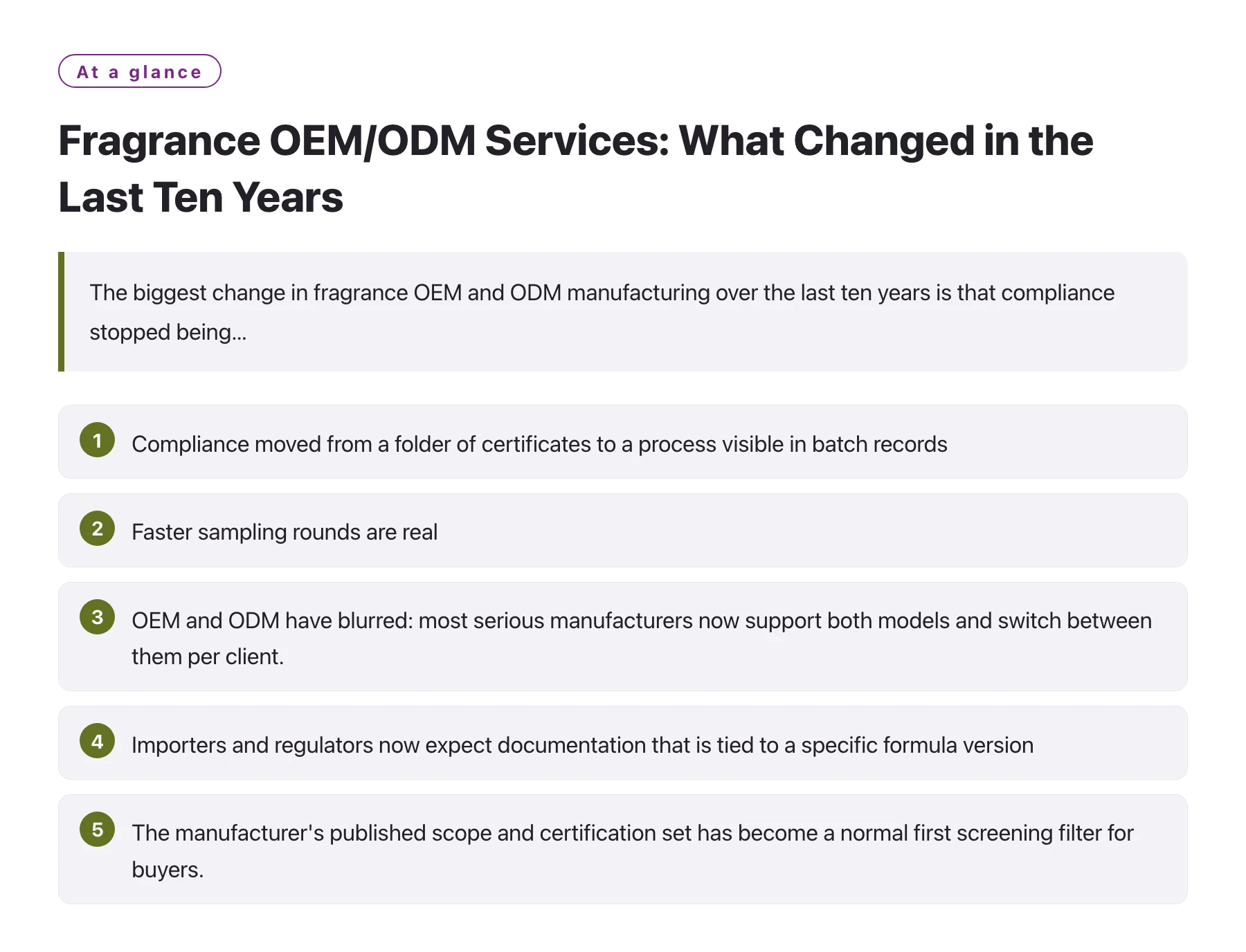
Key takeaways
- Compliance moved from a folder of certificates to a process visible in batch records, raw material traceability and safety assessments.
- Faster sampling rounds are real, but they made the gap between an approved sample and a bulk batch a more dangerous place for shortcuts.
- OEM and ODM have blurred: most serious manufacturers now support both models and switch between them per client.
- Importers and regulators now expect documentation that is tied to a specific formula version, not a generic template.
- The manufacturer's published scope and certification set has become a normal first screening filter for buyers.
Anyone who has bought fragrance manufacturing services for a decade has felt the change without being able to point at one event. It was not a single regulation or a single crisis; it was a slow shift in what 'good' means on every call with a factory.
This is a working note on the shifts that matter, written for buyers who last evaluated suppliers a few years ago.
Compliance became process, not paperwork
Ten years ago a factory's compliance story could be told with a wall of certificates. That story still exists, but it no longer carries the conversation. What changed is that the documents are now expected to connect to evidence: the batch record for this run, the raw material declaration for this lot, the safety assessment written against this formula version.
The frameworks themselves became more explicit too. The fragrance industry's safe-use standards, maintained by the International Fragrance Association, have been tightened and republished in a structured library over recent years [1], and the EU's detailed cosmetics rules — including the safety assessment obligations — are published as an explicit topic set that any buyer can read directly [2]. The consequence for a buyer: a supplier that cannot connect a certificate to a batch record is already behind the market's expectations.
Connecting the certificate to the batch
The practical test has not changed, but it has sharpened: ask to walk through one batch record from raw material intake to release. A factory that runs its management systems properly will open the file in minutes. One that cannot usually has a good story and a thin record.
Documents tied to a formula version
Importers now reject generic templates that do not name the exact formula, the dosage and the batch. The document set a manufacturer keeps on file — stability conclusions, ingredient declarations, the standards statement — is expected to version together with the product. This is a quiet but structural change in how files are kept.
The same conversation, ten years apart
| Topic | Then | Now |
|---|---|---|
| Compliance evidence | A folder of certificates | Batch records connected to certificates |
| Sampling | Fewer rounds, sent by courier | More rounds, faster, decided remotely |
| Safety documentation | A generic assessment | Versioned against the frozen formula |
| Models | OEM and ODM as separate choices | One manufacturer, both models, switched per client |
| Buyer screening | Referrals and price lists | Published scope and certification sets read first |
The uncomfortable part of this table is the sampling row. Faster decisions moved convenience onto the buyer's side of the table — and moved the risk of approving on too little information there as well.
Sampling got faster; the gap got more dangerous
Remote evaluation made sampling rounds quicker and cheaper, which is genuinely better. But the distance between an approved sample and a bulk order is where the industry's oldest problems still live: dilution, ageing, packaging compatibility, a change of raw material lot. The reasons why a sample and the bulk order can differ are the same as they ever were — the difference is that a buyer can now approve a sample without ever holding it, which removes the last sensory check before the first big order.
Keeping a physical reference in the loop
The fix is old-fashioned and cheap: a retained physical sample of the approved batch, held by both sides, with a date and reference. Every extra round of digital comparison should end with the physical sample going back to the factory as the agreed standard.
Both models, switched per client
The other structural change is that OEM and ODM stopped being separate doors. Serious manufacturers now run development libraries and client-owned formula work side by side, and the same client can start with an ODM base and move to an own-formula product later. The selection criterion shifted accordingly: a brand now looks for a manufacturer that supports OEM and ODM rather than choosing between two types of factory.
What the screening filter looks like now
Buyers increasingly start from the published record: the scope of fragrance OEM and ODM manufacturing services a company declares, the certifications it lists, the categories it says it runs. It is a coarse filter, but it is a real one — and it rewards manufacturers that document their own process, because the documentation is exactly what the buyer would have asked for three emails later.
Re-evaluate suppliers on the new questions, not the old ones. The file that matters is no longer the certificate folder — it is the batch record, the versioned safety file and the retained sample going back and forth on every order.
Sources
- IFRA: Safe Use and Fragrance Science —— IFRA's explanation of how fragrance materials are scientifically assessed for safe use and how those conclusions are applied by the industry.
- European Commission: Cosmetic Products — Specific Topics —— EU pages covering specific cosmetics topics such as product claims, nanomaterials and animal-testing rules.
Frequently asked questions
Has OEM or ODM become the better model in recent years?
Neither won. The change is that most manufacturers now offer both and switch per client, so the better question is which starting point fits the product and the first volumes — not which factory type to pick.
Why do importers now ask for versioned documents?
Because a safety file written for a different formula or dosage is worthless to an importer that carries the liability. Documents that name the frozen formula, the batch and the date travel through customs and retail checks far more smoothly.
Is faster sampling a real improvement?
Yes, for iteration speed. The risk moved to approval discipline: faster rounds make it easy to approve on a screen and skip the physical reference. Keep the retained sample step and the improvement is real.
What should I re-check if I last bought a few years ago?
The batch record walk-through, the versioned safety file and the factory's published scope. The certificate folder is still nice to see; the process that produces the records is what now separates suppliers.
How much of this is about China specifically?
The compliance and sampling shifts are global. What is specific to China is the breadth of manufacturers — from small compounding shops to full-range houses — which makes the screening filter more important, because the spread between the two ends is wide.